0
The Basics of Suppressors: What You Should Know
Whether you just picked up your first firearm or 50th, there’s a solid chance you’ve come across some fellow firearms owners talking about suppressors, seen them in the display cases at your favorite local gun shop, or even being used on the range.
However, even in an age where we have supercomputers in our pockets and the sum of human knowledge at our fingertips, there does seem to be quite a lot of fear, uncertainty, and doubt regarding suppressors. Even amongst longtime participants in our community of armed and prepared citizens, the myths about suppressors linger on and continue…
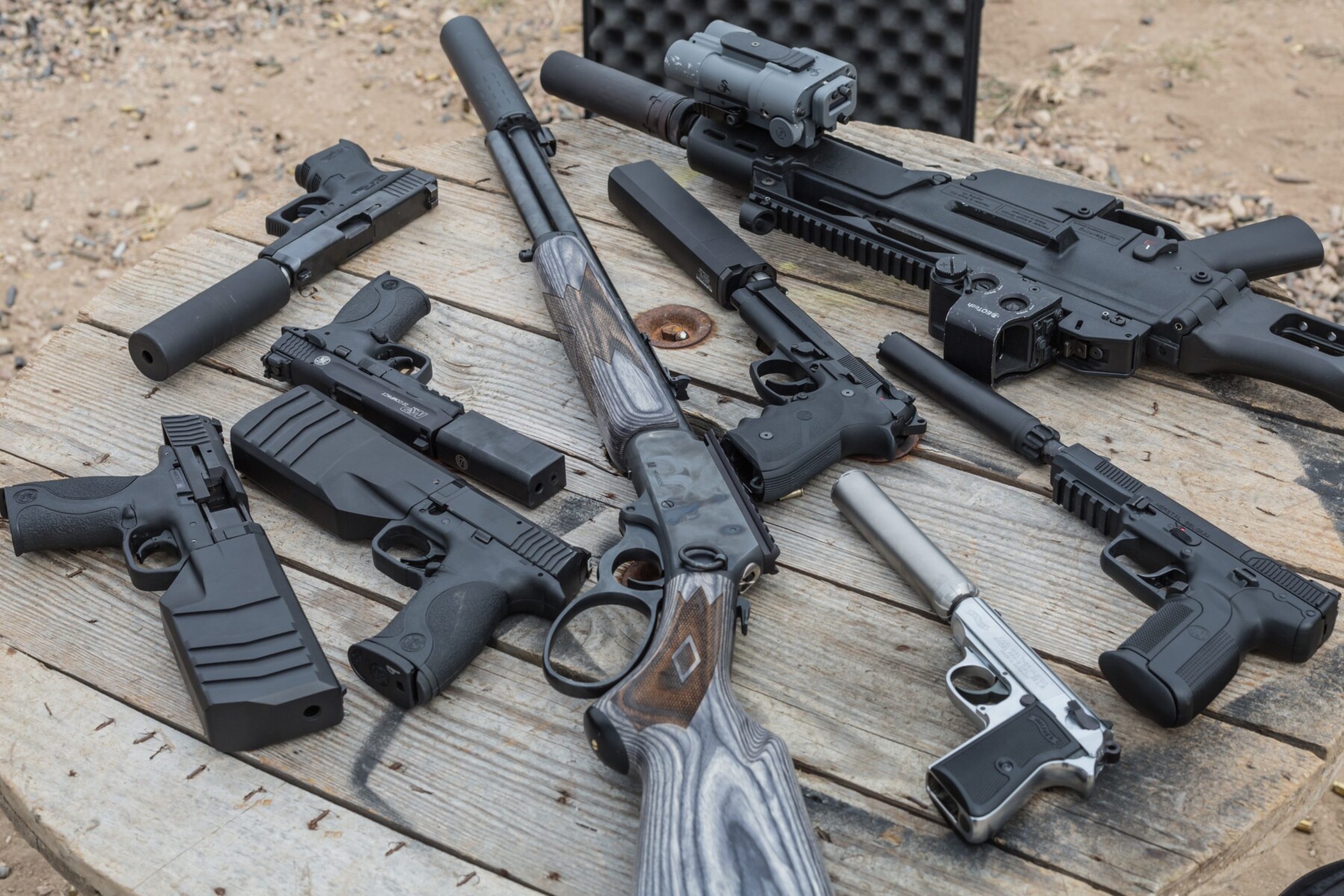
Suppressors come in all shapes and sizes. Source
Before we tackle the basics of how suppressors work, how to acquire one legally, and their history, we’ll take a quick detour and bust some myths about suppressors, aka “silencers”.
Mythbusting: The Reality Of Suppressors
For about as long as they have been around, suppressors have been the subject of myths and outright hysteria inside and outside the firearms community. With misconceptions about how much they really quiet down the sound of a gunshot (aka “Hollywood Quiet”) to judgements about who uses them, i.e. “Only hitmen and assassins use them!”, these humble devices have had a rough go of it, almost since their invention. However, you’ll find that the bad rap these fancy lengths of pipe have gotten is the result of bad information.
Without further ado, let’s bust some of those myths about suppressors.
Myth – Suppressors almost completely silence a gunshot, regardless of caliber.
Busted: No, not in the least. Aside from “doing it because we can” tests where guntubers specifically craft low-power subsonic .22 LR loads to render a suppressed rimfire pistol or rifle ultraquiet, your average suppressor will knock down the concussive blast of say, 5.56x45mm, down to a less-deafening 130 dB or so. Still quite loud, but not insanely so. With a suppressor, anyone in the area will know a gun is being shot, but it just won’t be as loud.
Myth – You need a permit/”Class 3 License” to own a suppressor.
Busted: No, but to be fair, it’s really a technicality. In the US, suppressors are subject to the vagaries and inane regulations of the National Firearms Act (NFA) of 1934. For legal purposes, suppressors were and are treated like actual firearms. Anyway, the NFA imposes severe and senseless restrictions on machine guns, short-barreled rifles, short-barreled shotguns, destructive devices (grenades and the like), and oddball weapons like disguised guns, i.e. guns that look like walking canes or cell phones.
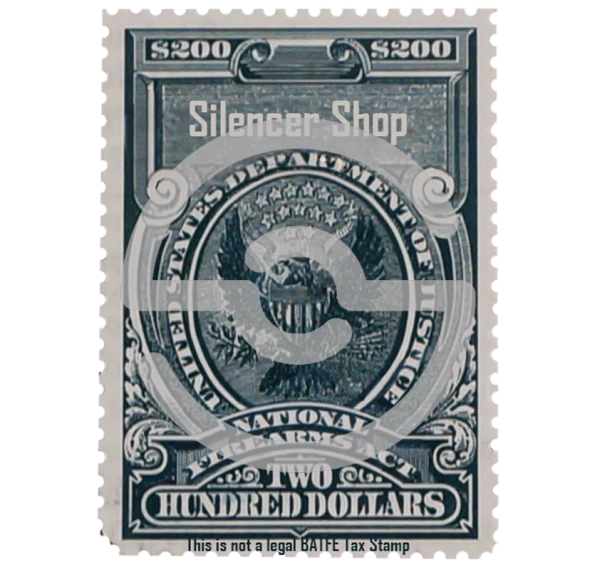
An expensive stamp. Source
The restrictions, which we’ll dive into later, include a $200 tax (thankfully for only a limited time longer) on the purchase of the suppressor and a registration requirement, where the owner files paperwork notifying the ATF of their suppressor ownership and residence. Once the process is complete, the owner receives a form with a stamp attached to it, indicating that the $200 tax has been paid. A receipt, in essence. Some call it a permit, which in a mundane sense it is, but it really isn’t. It’s actually a confidential tax form. Technically, the only people who can view it without asking are ATF agents. Private citizens have to pound sand, and regular cops need a warrant.
Myth – Suppressors are only used by terrorists/assassins/ninjas/hitmen.
Busted: Well, sort of. There are plenty of photos on social media these days of Hamas terrorists using suppressed weapons, but in that case, it’s incidental. They were either supplied by bad actors or the weapons were stolen from local sources such as the IDF, Jordan, etc. However, outside of a war, suppressors are used by all manner of firearms owners acting in a peaceable manner. Here in the US, they have become quite popular in the hunting and self-defense communities. Overseas, in some nations, the suppressor is no more restricted than the guns themselves, with local authorities encouraging their use to keep the noise down during hunting season. It’s literally just a fancy variant of a car muffler.
With some myths busted, let’s get into the history of suppressors.
The History Of Suppressors
Until the early part of the 20th century, no one had given much thought to the noise generated by firearms, or for hearing protection at all, for that matter. If you worked around loud things or were into firearms, hearing damage was just part and parcel of the trade. Tinnitus must have been rampant.
Enter Hiram Percy Maxim. Son of Hiram Stevens Maxim, the inventor of the modern machine gun, H.P. Maxim undoubtedly felt a little overshadowed by his legendary father. Becoming a genius in his own right, the junior Maxim graduated from MIT at the age of seventeen. Before he turned thirty, he developed a gasoline-powered tricycle and an electric car called the “Columbia”. While working for the Columbia Auto Company, Maxim noticed that gas engines were loud. Envisioning thousands on the streets, he looked for ways to fight the noise and invented the automobile muffler.
Inspired, he turned his attention to the task of reducing the sound signature of a firearm. Leaving Columbia Auto, Maxim founded the Maxim Silent Firearms Company, specifically to develop the first firearm suppressor, also known as a silencer. Finally, in 1909, he patented the Maxim Silent Firearm. Basically a pipe with curved vanes inside, the Maxim Silencer forced the heat and gases of a gunshot into little vortices, slowing them down, cooling them, and absorbing their sound signature. With an off-center attachment, the Maxim Silencer could be attached to any rifle of the caliber noted on the device and not require modification of the sights.
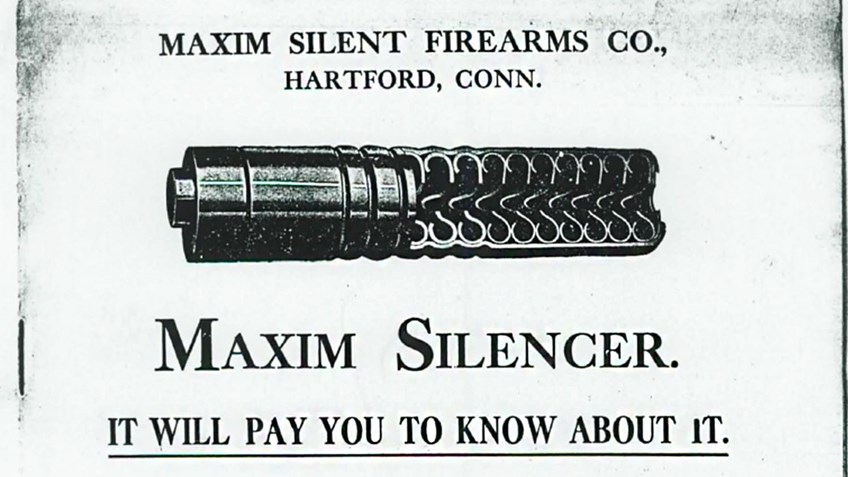
It will pay you to know about it. Source
Soon after, the US military took an interest in the Maxim Silencer. However, the Great War (World War 1) was on the horizon, and the armed forces had more urgent priorities to deal with besides some newfangled gun muffler. However, the negative press had already started. Despite the fact that at the time, no national-level gun control existed, the yellow press took to calling Maxim’s silencer a “tool for pistol-armed criminals”, despite the fact that the device could not be attached to a pistol without causing it to malfunction.
Maxim and his company continued making firearm silencers until about 1930, when a combination of negative press and low sales forced him to cease manufacturing his original innovation. To remain above water, Maxim’s company shifted priorities to quieting industrial machinery, which it continues to do today.
Suppressors Were A Niche Item For Decades
From the 1930s until about the 1990s, suppressors experienced a lull in terms of sales and development. Ironically, the most significant innovations in the 1940s were from the British. During World War 2, the Brits developed a taste for suppressed firearms for their special operators, causing much-deserved chaos for the Nazi regime. Amongst their designs were the Welrod pistol, a manually-operated pistol chambered in .32 ACP, 9mm, and some other calibers depending on mission. The Welrod was integrally suppressed, i.e., the suppressor was part of the firearm, and since the user had to manually work the action after each shot, the weapon was even quieter. It was specifically meant for covert work, and was definitely the “assassin’s weapon” that the press got all heated about.
On the US side, suppressors were still essentially custom-made items for military users. A specific unit or agency would request a silencer, and the work would be farmed out to a defense contractor to develop and fulfill the request. For the most part, the public thought the devices were illegal for citizen ownership. Which was true in a lot of places, as states and cities put anti-suppressor laws on the books, to block even NFA ownership of “cans”.
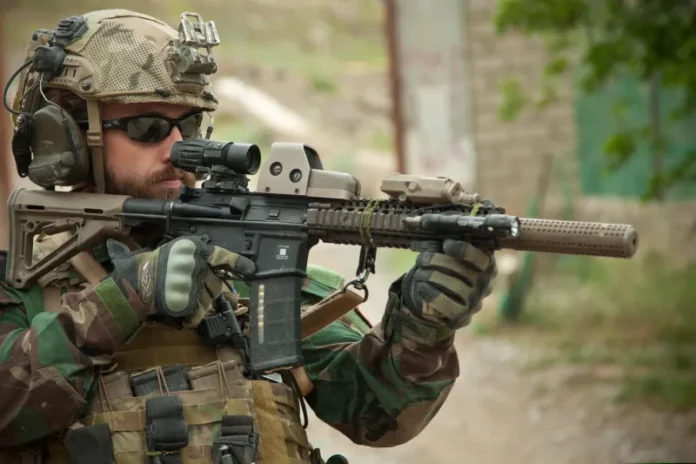
Blending in and staying quiet. Source
The late 1970s finally saw some changes, with a company called Qual-A-Tec pushing the science forward. Founded by Charles “Mickey” Finn, Qual-A-Tec took the science of fighting the noise seriously and came up with major innovations. Spurred on by requests from the usual batch of clandestine operators, Finn’s suppressors utilized durable alloy baffles and, most importantly, closely matched the diameter of the silencer bore to the caliber being shot. Still very bulky, Qual-A-Tec suppressors were nonetheless the “choice” of the special operations community throughout the 1980s. As an aside, Finn also invented the Neilsen device and the K-style baffle, both of which remain cornerstones of suppressor design today.
Suppressors, being the domain of well-heeled collectors and the military, continued to be the status quo until the late 1990s. Like everything else in the world, the internet changed everything. Myths were being busted, most notably that suppressors were flat-out illegal for citizens to own. Forums such as ar15.com and silencertalk.com surfaced, providing community and guidance for suppressor ownership. Companies like Silencerco were established, specifically targeting citizen users. Though still bound by the restrictions of the NFA, companies such as Silencerco report a consistent uptick in suppressor sales, especially with most states, except for the usual suspects, making suppressor ownership legal as long as the buyer stays consistent with federal law.
How Suppressors Work
Though throughout their history, suppressors have been thought to function by means of black magic and alchemy, the concept of their operation is really quite simple.
The suppressor attaches to the muzzle of the firearm, either via a direct thread or a usually proprietary quick-detach mount. Once secured, it’s ready for action.
After the user presses the trigger, the projectile flies down the barrel and leaves the gun. The suppressor baffles strip gas away from the bullet’s path after it leaves the muzzle, forcing the gas to do work inside the suppressor. This process dissipates this energy and subsequently slows the explosive gas forces down, while keeping the sound of the gas expansion contained inside. In a proper suppressor design, the gas leaves the firearm in a slow and much quieter manner.

The more you know! Source
This same forced and controlled expansion tends to cool muzzle gases as well, further dissipating their energy. Of course, all that energy has to go somewhere, and it’s usually in the form of heat. That’s why a suppressor, even after a few rounds, will be hot to the touch. A few mag dumps, you could literally cook bacon if it were wrapped around your can.
Very similar to a car muffler, the suppressor merely cools, muffles, and slows down the actions of a rapidly expanding gas.
However, suppressors do not silence a firearm entirely. The mechanical noises of the firearm, i.e., the movement of the slide or the bolt carrier group moving back, are not suppressed. You’ll hear them in operation. And the projectile itself will create the usual sonic crack when it breaks the sound barrier.
Which brings up another factor – supersonic versus subsonic ammunition.
Supersonic & Subsonic Ammunition
The projectile itself will always generate noise as it flies out of the barrel, and even more so when it breaks the sound barrier. Much like an aircraft breaking Mach 1, a bullet going that speed or better (761 miles per hour/1225 kilometers per hour/1116 feet per second) will generate a sonic boom as it passes that speed. In the case of a bullet, the sound will be a sharp and pronounced “crack”.
There’s no process that can muffle that sound and keep the bullet supersonic. Thus, the only solution is ammunition that is produced to be subsonic.
Now, if you shoot .45 ACP, you’ll be doing this by default. This reason is also why .45 ACP tends to be popular with pistol shooters who use suppressors. With no sonic boom to worry about, the only noise produced is the muffled “angry nail gun” sound of a suppressed rifle, and the sound of the bullet zipping through the air, but not breaking the sound barrier.
For rifle shooters, it’s a little more difficult. For example, 5.56mm streaks along at around 3,000 feet per second. In order to be subsonic, that velocity has to be chopped down by 2/3rds. The usual process is to “download” the round’s powder. However, in most cases, when a round is set up this way, it lacks sufficient energy to cycle the firearm and bring the next round into battery. Your AR-15 with subsonic 5.56mm ammo loaded up (yes, it exists) then becomes a rather strange single-shot rifle. You shoot the round, then you manually work the charging handle to bring the next round up. Of course, this can lead to malfunctions. In most cases, subsonic 5.56mm is really just for fun.
Heavier rounds, such as .308, can be loaded for subsonic use, and the heavier projectile does impart more recoil, allowing for the action of the host weapon to cycle, in most cases.
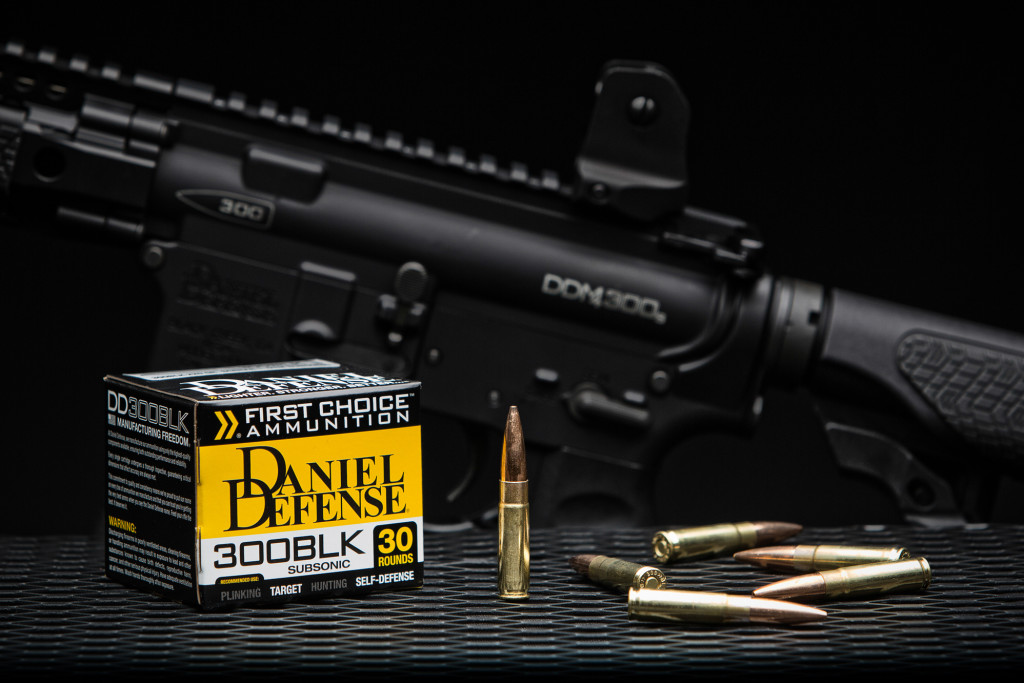
Now that is going to be a quiet setup! Source
More recently, the suppressor community has taken to .300 Blackout, aka 300 BLK, for subsonic fun. Designed less than 20 years ago, the round was optimized for suppressor use, whether in a supersonic or subsonic configuration. Even better, 300 BLK rounds will load into a conventional AR-15 magazine or a dedicated .300 BLK magazine. Converting your existing 5.56mm AR-15 to 300 BLK is as easy as swapping the barrel or the complete upper.
However, the tradeoff of subsonic ammunition in any caliber is its terminal performance. You’re trading energy for sonic signature. A supersonic 300 BLK round will be effective out to around 400 meters. Subsonic? 100 meters if you are lucky. Thus, most subsonic cartridges are designed to be used at close ranges.
Suppressed shooting is a balance between ammunition selection and suppressor selection. The trick is, you’ll need to acquire a suppressor, of course.
So, how is that accomplished? Legally, of course.
How To Legally Purchase A Suppressor
As of this writing, suppressors are legal for citizen possession and use in 42 states, and can be used lawfully for hunting in 41 states. The holdouts are the states you’d expect, of course. No surprises there.
That being said, it’s worth mentioning that legally, suppressors are called silencers. In any legislation or government documentation, the term is used, despite it being technically inaccurate.
Anyways, with that out of the way, how do you legally acquire a suppressor?
Pick And Purchase A Suppressor
Note: The following should only be used as a guideline. For the up-to-the-minute dirty details, contact an FFL or an attorney.
After a deep dive into your use cases and budget, you’ll want to buy a suppressor. You can purchase one online, even. Legally, it’s a firearm, so of course, it has to be transferred to an FFL that holds a Special Occupancy Tax (SOT) license, unless using a service like that of Silencer Central to have it shipped straight to your door. Unlike an actual gun, though, the process of final acquisition differs greatly.
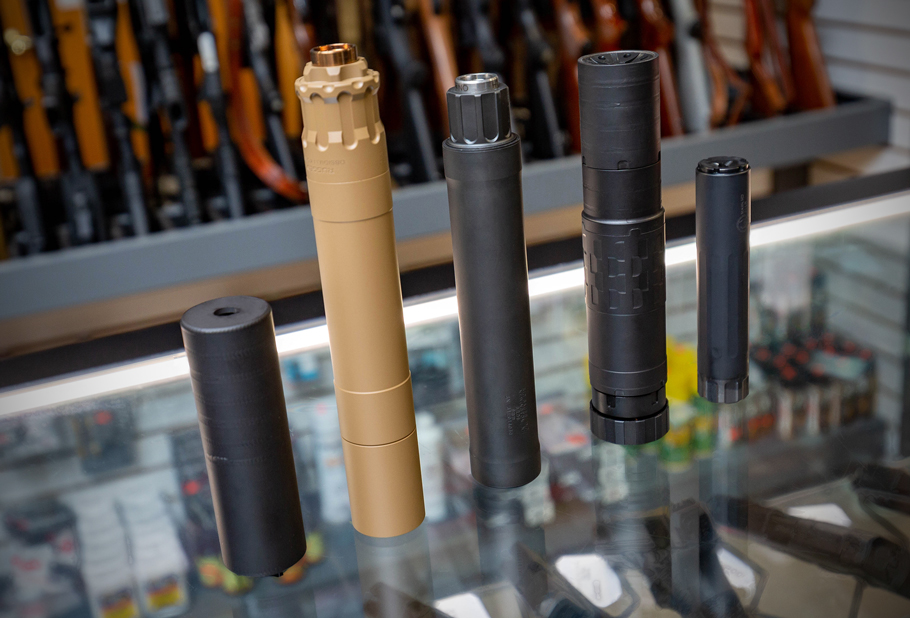
Your local range will likely have several suppressors to compare. Source
Whether you purchase a suppressor online, or purchase it in person at a gun shop, you’ll need to have your paperwork in order to finalize the purchase. Specifically, you will need:
– Passport Photo Of You And Any “Responsible Persons” (more on this in a minute…)
– Valid driver’s license showing your current address
– Method of payment
– Completed FD-258 fingerprint cards (Most shops selling NFA items now have these on hand, though.)
– Your ATF eForms login ID
Individual Purchase vs Trust Purchase
A suppressor (or any other NFA item) can be acquired by an individual or a trust.
The individual route is, as it sounds, you fill out the paperwork as yourself. You place all your personal information in the paperwork or in eForms; however, only you can use it. Well, technically, others can use it, but you have to be with them. The individual route also requires that the chief law enforcement officer of your jurisdiction be notified of your possession of the suppressor. Protip: pick the state attorney general. They are considered a CLEO and have many other things to worry about besides NFA items. All they have to do is acknowledge receipt, which is easily accomplished by registered mail.
The trust route is a little different. In a very broad sense, a trust can be thought of as a corporation. There are members, each with a role and legal rights to the items in the trust.
The trust will contain the names of the people involved in the trust, such as yourself, and anyone else you may want to have access to your NFA items. This is useful in a household where a husband wants his wife to legally be able to take a suppressed weapon to the range, for example.
In a trust, you can also define who the beneficiaries of the items are – so, for example, if you pass on, the NFA items can be passed tax-free to your heirs, although they have to file a Form 5 with the ATF to do so.
Another thing to consider is that the trust must be notarized before the purchase process is complete. Often, FFLs will have an employee who is also a notary, or ready access to one if needed.
In both the individual and trust routes, a Form 4 (Application for Tax Paid Transfer and Registration of Firearm) is filled out to be submitted to the ATF. Also, during the submission process, whether done via eForms or by paper, the NFA tax is paid (for now). In the case of eForms, it’s electronic. In the case of the manual paper process, a check or money order is cut, and the paperwork is sent to the IRS first (since the NFA is a tax), where the payment is processed. After that, the NFA paperwork itself is sent to the NFA processing center in Martinsburg, West Virginia.
After the stacks of paperwork, you’re still not done. Now, you wait.
The Interminable Waiting Period
The ATF currently maintains a web page where the various NFA wait times are listed. As of writing this, the processing times for a Form 4 (individual) is 68 days (paper) and 16 days (eForms), and a Form 4 (trust) is 112 days (paper) and 8 days (eForms). As you can see, the quickest ways are the electronic methods. The entire process is the punishment. Remember, the NFA was designed to discourage people from purchasing NFA items without outright banning them.
However, as of now, those are the cards we’ve been dealt, unfortunately.
There’s a trick, though. During the wait time, your suppressor is in a bit of a grey area. Since you paid for it, it belongs to you. But you cannot take it home. It has to remain in the possession of an FFL until they receive your approved Form 4. However, in the interim, you can use the suppressor, provided it doesn’t leave the possession of the FFL or its employees. Thus, it’s handy to purchase your suppressor via a firearms shop that has an attached range, or have it transferred to an FFL (who is approved to sell NFA items, some cannot…) that has an attached range. That way you can run your can until it’s time to take it home.
When that time arrives, the FFL will notify you that your approved Form 4 has come back, and then it’s off to the races. You, or if you have a trust, any trustee, can go to the FFL and pick up the can. Since the NFA background check was completed at the ATF, the only thing that needs to happen at the FFL is filling out a Form 4473. In this case, the 4473 logs that the firearm (suppressor) has been transferred to you. The FFL only needs to check a box on the 4473 that indicates it’s for an NFA item.
And then, you’re the proud owner of a shiny new device that basically amounts to a high-tech car muffler. Let the fun begin.
The Future Of Suppressors
With the streamlining of the NFA process and the rapid availability of information on suppressors, they have become quite the status symbol in the firearms community. However, each and every suppressor owner has strenuous objections to the acquisition process, as it basically amounts to a massive political delay.

It’s about time! Source
The suppressor industry is poised for deregulation now more than ever. New manufacturing techniques such as 3D printing have enabled amazingly strong and cost-effective suppressors to be produced, in volume.
For now, we’ll need to stick to our guns and keep fighting the noise.