0
Ordering a standard-capacity magazine online is legal in most of the United States, yet the same purchase may create legal issues in certain states. Magazine capacity laws vary widely, and the differences are not always obvious. Some states restrict possession, others restrict sales or transfers, and many include exceptions or local ordinances that override state law.This guide explains gun magazine capacity laws by state, focusing on what matters to buyers. You will find what states restrict magazine capacity, current capacity limits, how each law applies, where restrictions are more stringent at the local level, and what this means when ordering magazines online. Legal Disclaimer: For informational purposes only. Not legal advice. Laws change quickly, and court rulings or new bills can alter the rules with little notice. Always verify the current state and local law before you buy or use any magazine.
Quick Reference: Magazine Capacity Limits by State
As of April, 2026, 14 states and the District of Columbia have put some limit on magazine capacity across the state: California, Colorado, Connecticut, Delaware, Hawaii, Illinois, Maryland, Massachusetts, New Jersey, New York, Oregon, Rhode Island, Vermont, Washington, and D.C. Most use a 10-round limit. Colorado sets the limit at 15 (with stricter limits in certain counties), Delaware limits to 17, and both Illinois and Vermont have different limits by firearm type, with Illinois also having stricter limits by county as well. As you can see, it can be quite difficult to keep track of!
Restricted Jurisdictions Chart
| Jurisdiction | Limit | Applies to | Possession Banned | Key Note |
| California | 10 | All firearms | Yes | Ninth Circuit upheld the law in 2025; cert petition remains pending at SCOTUS |
| Colorado | 15 | All firearms | Yes, with grandfathering | Boulder city and county local rules are stricter |
| Connecticut | 10 | All firearms | Yes, with grandfathering/registration | Legacy mags had to be declared |
| Delaware | 17 | All firearms | Yes | Unusual 17-round threshold |
| District of Columbia | 10 | All firearms | Statute says yes, but enforcement is contested | D.C. Court of Appeals struck down the ban on March 5, 2026; further review remains possible |
| Hawaii | 10 | Handgun magazines | Yes | State rule is handgun-specific |
| Illinois | 10 long guns / 15 handguns | All firearms | Yes, with legacy limits | Chicago / Cook can be stricter in practice |
| Maryland | 10 | All firearms | Generally no | Sale, transfer, receipt, purchase, and manufacture are restricted; possession is generally not |
| Massachusetts | 10 rifle/pistol, 5 shotguns | All firearms | Yes, with legacy rules | Pre-1994 history matters |
| New Jersey | 10 | All firearms | Yes | The previous 15-round limit was cut to 10 |
| New York | 10 | All firearms | Yes | The old 7-round load rule was struck; 10 remains the core statewide rule |
| Oregon | 10 | All firearms | Law remains in litigation/implementation flux | Measure 114 remains a live compliance risk |
| Rhode Island | 10 | All firearms | Yes | Possession penalties are serious |
| Vermont | 10 long guns / 15 handguns | All firearms | Yes, with grandfathering | Split-capacity state |
| Washington | 10 | All firearms | No general possession ban | Sales, imports, distribution, and manufacturing are banned |
In the rest of the country, according to the magazine laws by state 2026, there is no statewide magazine-capacity limit on the books, which generally mirror these bans, though local ordinances can still matter. That distinction is important: “no statewide restriction” does not always mean “safe to order without checking county or city law”.
Understanding Magazine Capacity Laws: The Basics
Magazine capacity laws regulate how many rounds a magazine can hold or be modified to hold. Most states that enforce these laws define a “high-capacity magazine” as one holding more than 10 rounds, although some states use different thresholds.For buyers, the real dividing line is not the label. What matters is how the law applies. A state may:
- Ban possession entirely
- Restrict only the sale or transfer
- Allow previously owned magazines under strict conditions (“grandfathered” mags)
- Regulate how magazines are transported or used
Factors like these usually matter more in practice than the product label says. This affects whether the magazine is legal to own, buy, or ship.
Federal Background and Legal Foundations
There is no current federal magazine-capacity ban. Congress created a federal large-capacity ammunition feeding device ban in 1994, defining the term as a magazine or similar device capable of accepting more than 10 rounds, but that federal law sunset in 2004. Since then, magazine-capacity regulation has largely been a matter of state and local law. After the 2004 federal sunset, individual states and localities began enacting their own magazine capacity restrictions. This created the current landscape: a fragmented system in which some states impose strict limits, others allow unrestricted magazines, and still others fall somewhere in between. A magazine legal in one state may be illegal in another, and reciprocity does not apply. President Trump’s February 7, 2025, executive order on Second Amendment Rights directed the Attorney General to review federal actions and propose a plan, but it did not preempt or invalidate state magazine laws. For buyers, that means the executive order did not suddenly reopen California, New Jersey, or New York for unrestricted magazine sales.
How States Define High-Capacity Magazines
Definitions of high-capacity magazines often extend beyond the magazine’s current round count. Many state laws also cover magazines that can be readily restored or converted to exceed the legal cap. That language matters for blocked, pinned, altered, or extension-ready magazines. A buyer who assumes a magazine is compliant because it currently ships with a limiter can still run into trouble if state law treats it as readily convertible.
Key Differences in State-Level Restrictions
Magazine capacity rules aren’t all the same, and those differences matter for what you can buy or carry around. The first distinction is what the law actually prohibits. Some states, such as New York and New Jersey, outlaw both the possession and sale of high-capacity magazines. Some other states just target businesses, not individuals. Maryland, for example, bans the manufacture, sale, or transfer of magazines that hold more than 10 rounds, yet generally allows possession. That detail makes a big difference: sometimes you can’t buy new magazines locally, but you can keep a magazine you already own. Another critical factor is the presence of grandfather clauses. States such as Connecticut, Vermont, and Massachusetts allow you to keep magazines purchased before a certain date, though they tend to impose conditions. You might have to register them, only bring them to certain places, or avoid selling them to someone else. If you don’t have the right paperwork or don’t follow those rules, a magazine that was once fine could suddenly be illegal. Laws often include wording about magazines that are “readily convertible” to hold more rounds than they’re supposed to. This applies to modified or blocked magazines that can be restored to higher capacity with minimal effort. Buyers sometimes miss that part, but states pay close attention to it when deciding what counts as legal. Crossing state lines adds another layer of complexity. The minute you cross the border, what was legal at home might not be as soon as you enter another state. There’s no universal protection for magazines just because you’re passing through, so you really need to check every state’s rules along your drive.
14 States +D.C. With Magazine Capacity Restrictions – State-By-State Breakdown
California – 10-round limit
California Penal Code § 32310 broadly prohibits manufacturing, importing, selling, giving, lending, or possessing magazines that hold more than 10 rounds. Of all the states, California is typically the strictest state for magazine buyers, and many retailers refuse to ship magazines there rather than risk it with “compliant only” orders. The current litigation posture matters. In Duncan v. Bonta, the Ninth Circuit sitting en banc held on March 20, 2025, that California’s large-capacity magazine law comports with the Second Amendment. A cert petition is pending at the U.S. Supreme Court, but until the Court says otherwise, California’s 10-round framework remains the operative rule. Separate 2025-2026 California bills, including AB 1127 and AB 1078, affect other firearms issues and reinforce the broader tightening of California firearms law, even though they are not the core source of the 10-round magazine cap.
Colorado – 15-round limit
Colorado prohibits selling, transferring, or possessing magazines over 15 rounds, except for people who had those magazines before July 1, 2013, and have kept them ever since. That makes Colorado less simple than its headline number suggests. You need to be able to prove you’ve legally owned the magazine. The real headaches come at the local level. Regions like Boulder and Boulder County have even stricter rules (Colorado Senate Bill 21-256), which is why buyers can’t only check state law. Just living in Colorado doesn’t make things simple. Determining factors such as the city and ZIP code matter.
Connecticut – 10-round limit
Connecticut generally bans the sale, distribution, importation, or purchase of magazines containing more than 10 rounds and also regulates possession. Magazines legally owned before January 1, 2014, had to be declared under the state’s system. If you’re a new resident of Connecticut, saying “I’ve had it for years” won’t automatically solve the problem, as you’ll need proof from before the cutoff date and the right paperwork.
Delaware – 17-round limit
Delaware’s statewide limit is 17 rounds, which is less aggressive than most restricted states and matters a lot for handgun magazines, since a lot of standard ones fall under that threshold. Delaware is a useful example of why “restricted” doesn’t always mean “10-round” state. This unusual limit leads to both easier compliance and plenty of confusion. A 15- or 17-round magazine can be lawful in Delaware, but totally illegal in neighboring jurisdictions.
District of Columbia – 10-round limit, but actively contested
The D.C. Code § 7-2506.01 says that no person may knowingly possess, sell, or transfer a large-capacity magazine holding more than 10 rounds. On paper, it’s a flat 10-round rule. The complication is Benson v. United States. On March 5, 2026, the D.C. Court of Appeals decided that D.C.’s law banning magazines over 10 rounds violates the Second Amendment and overturned Benson’s conviction. The court did say the District could try for rehearing or appeal, so the legal status is still unsettled. The law is technically still in place, but everyone’s cautious because things are changing. Retailers are likely to keep playing it safe until the posture fully settles.
Hawaii – 10-round limit for handgun magazines
Hawaii’s statewide restriction applies to detachable magazines that hold more than 10 rounds, but here’s the key: it applies only to magazines designed for or capable of use with a pistol. That handgun-specific scope matters because the rule is not written as a universal cap on every rifle magazine in the same way California’s rule is.A buyer who sees “Hawaii = 10 rounds” and misses the part about handguns is likely to misread the law. That handgun-specific nature of the statute is the real compliance point.
Illinois – 10 rounds for rifles, 15 for handguns, 5 for shotguns
The Protect Illinois Communities Act, Public Act 102-1116, splits magazine limits: rifles are capped at 10 rounds, shotguns are capped at 5 rounds, and handguns are capped at 15 rounds. The law also covers devices that can be easily restored or converted, and includes special legacy-magazine rules with limited lawful locations and circumstances. Illinois is a state where local rules and shipping restrictions can get tricky. Chicago and Cook County have their own ordinance history, and Chicago bans high-capacity magazines and shotgun tube extensions that exceed the local threshold. For retailers, zip codes matter here, as what’s allowed in one town could be illegal just a few miles away.
Maryland – 10-round limit
Maryland is often misunderstood because, unlike New Jersey or New York, it is not a straight possession-ban state. Maryland law §4-305 says you can’t manufacture, sell, offer for sale, purchase, receive, or transfer magazines holding more than 10 rounds – but simply owning one is generally lawful. That difference is big for buyers: living in Maryland, you might be allowed to keep a 15-round magazine you already have, but picking up a new one in-state is a different issue. This is one of the best examples of why “Can I own it?” is not the same as “Can I buy it here?”, which are different legal questions.
Massachusetts – 10-round limit for rifles and pistols, 5-round limit for shotguns, with legacy complications
Massachusetts restricts rifle and pistol magazines to over 10 rounds and shotgun magazines to over 5 rounds (Chapter 140, § 121 in General Laws) unless you’re talking about ones made before September 13, 1994 – that old federal ban date still plays a part in what’s legal here, which can catch new buyers off guard. Massachusetts is also one of the states where shotgun-capacity issues deserve attention, because buyers often focus only on pistol and rifle magazines and overlook how “large capacity” definitions can intersect with shotgun devices and platform-specific rules.
New Jersey – 10-round limit
New Jersey switched to a 10-round cap for magazines statewide; the earlier 15-round rule is no longer the operative rule. Buyers relying on outdated forums or old packaging often miss this. The NJ law is broad and possession-focused, which is why compliant 10-round factory magazines dominate the lawful retail market here. The practical takeaway is simple: New Jersey is now a 10-round state, not a “ship it if under 15” state anymore.
New York – 10-round limit
The SAFE Act in New York first introduced a seven-round rule, but that part got dropped. For all practical purposes, the statewide standard (Penal Law §§ 265.00) is a 10-round limit for magazines. New York is also one of the most important travel-risk states: local enforcement can be aggressive, and the SAFE Act makes it risky to ship magazines across state lines. Anyone thinking about bringing a magazine into New York should be extra careful.
Oregon – 10-round law remains a live compliance issue
Oregon’s Measure 114 includes a ban tied to magazines over 10 rounds, along with permit-to-purchase and completed-background-check requirements. Earlier, the Oregon Court of Appeals overturned a lower court block on these restrictions, and the state Supreme Court was already weighing the issue. Meanwhile, lawmakers have been moving forward with implementation bills like HB 4145, which are directly tied to exactly when and how Measure 114 becomes operative. For buyers, Oregon is not a “safe because unresolved” state. Things change quickly, and retailers tend to play it safe by not shipping any magazines with more than 10 rounds, even as legal battles and rule changes continue to move.
Rhode Island – 10-round limit
Rhode Island’s law bans possessing, selling, or buying magazines with more than 10 rounds. Breaking this rule (R.I. Gen. Laws § 11-47.1-2) can land you in serious trouble. As the rules are strict, it’s smart to double-check the seller’s policy first, since many won’t ship to Rhode Island under any circumstances.
Vermont – 15 rounds for handguns, 10 for long guns
Vermont does things a little differently (13 V.S.A. § 4021): handguns can take up to 15 rounds, but long guns (like rifles and shotguns) are limited to 10. If you had a magazine before October 1, 2018, it’s grandfathered in. It is another good reminder that “Vermont is restricted” tells you very little unless you also know what firearm type is involved. For rifle and shotgun buyers, that 10-round rule often gets overlooked, since most of the attention focuses on handguns.
Washington – 10-round limit, but not a general possession ban
Washington’s statute, RCW 9.41.370, prohibits the manufacturing, importing, distributing, selling, or offering for sale of large-capacity magazines with over 10 rounds. But it does not create a general possession ban in the same way some other states do. On May 8, 2025, the Washington Supreme Court upheld ESSB 5078 in State v. Gator’s Custom Guns, finding it doesn’t break state or federal constitutional law. There’s still a petition at the U.S. Supreme Court, but as of now, Washington’s limit is fully in force.
Shotgun Magazine Restrictions by State
Shotgun magazine capacity rules often fly under the radar, even for those who know their way around gun laws. It’s a real problem, as most buyers see “magazine law” and think only about detachable pistol and AR magazines only. But under Illinois law, long-gun magazines are usually capped at 10 rounds, and some semiauto shotguns have an even stricter 5-round capacity. Chicago also regulates shotgun tubular magazine extensions. Washington’s broader large-capacity magazine rule is not written as a pure detachable-rifle-only statute, and Illinois, Massachusetts, and local ordinances in places like Boulder and Chicago can create practical shotgun compliance issues. For retailers and buyers, shotgun capacity deserves its own review rather than an afterthought under “rifle mags.”
Municipal & County-Level Restrictions: Local Laws That Override Your State
Local rules are where most people get caught off-guard. Boulder and Boulder County in Colorado, for example, have their own stricter regulations (stricter than the state’s 15-round rule). In Illinois, Chicago has its own municipal code that restricts high-capacity magazines and shotgun tubular extensions. In Ohio, Columbus put in a 30-round magazine ordinance even though the state itself has no comparable statewide cap. The Ohio Supreme Court is still dealing with the litigation over Columbus’s local gun laws. So the best advice isn’t just “check state law”, you really have to look at county and city rules too. A compliant product at the state level can still be blocked by a municipal ordinance or a retailer’s local-compliance filter.
Traveling Across State Lines With Magazines
The federal Firearm Owners Protection Act (FOPA), under 18 U.S.C. § 926A, protects interstate transport of unloaded firearms under certain conditions when the firearm is legal at both origin and destination and is not readily accessible during transport. The statute expressly speaks in terms of firearms and transport conditions; it does not give buyers a clean, nationwide “magazines are exempt” answer. That makes traveling through areas like New York, New Jersey, California, or D.C. tricky. The safest practice is to keep firearms unloaded, transport them directly between lawful endpoints, lock them away from the passenger compartment, and avoid carrying prohibited magazines into a jurisdiction that bans possession unless you have current legal advice specific to your route.
Buying Gun Magazines Online: What Every Buyer Should Know
Ordering gun magazines online is usually simple in a lot of states, but there are a few legal details that buyers should pay close attention to. Start by checking the capacity limit in your state (this guide can help you with that), then confirm how the law applies. Some states ban owning higher-capacity magazines, while other states only restrict buying or selling, and a few states let you keep them under certain rules. This matters because whether something is legal to ship isn’t always the same as whether it’s legal to own. Next, look at what kind of gun the magazine fits. Illinois and Vermont, for example, set different limits for handguns and long guns, and Hawaii focuses on handgun magazines. So, a mag that’s fine for a rifle may still be off-limits for a pistol, even in the same state. Pay close attention to local laws and ZIP code restrictions. Some cities or counties have rules that are even stricter than the state’s rules. Chicago and Boulder are classic cases: local laws there can be tougher than what the state says. Lots of online sellers check ZIP codes to avoid sending magazines into those restricted municipalities. Also, review how your state handles “readily convertible” magazines. If you buy a pinned or modified mag that could be restored to higher capacity with minimal effort, some states consider it illegal. Going with a factory-made, compliant mag is usually a safer option. Every retailer has their own shipping policy. Some will be more cautious than the law requires, especially if legal challenges are happening or the rules are confusing. They might only ship products that clearly fit the law, or just refuse orders altogether, depending on the state you live in. Thus, before placing an order, double-check the magazine’s capacity, which gun it’s for, any local restrictions, and the seller’s policy. Spending a couple of minutes on the details up front makes it much less likely you’ll run into issues later.
States Where We Cannot Ship Magazines
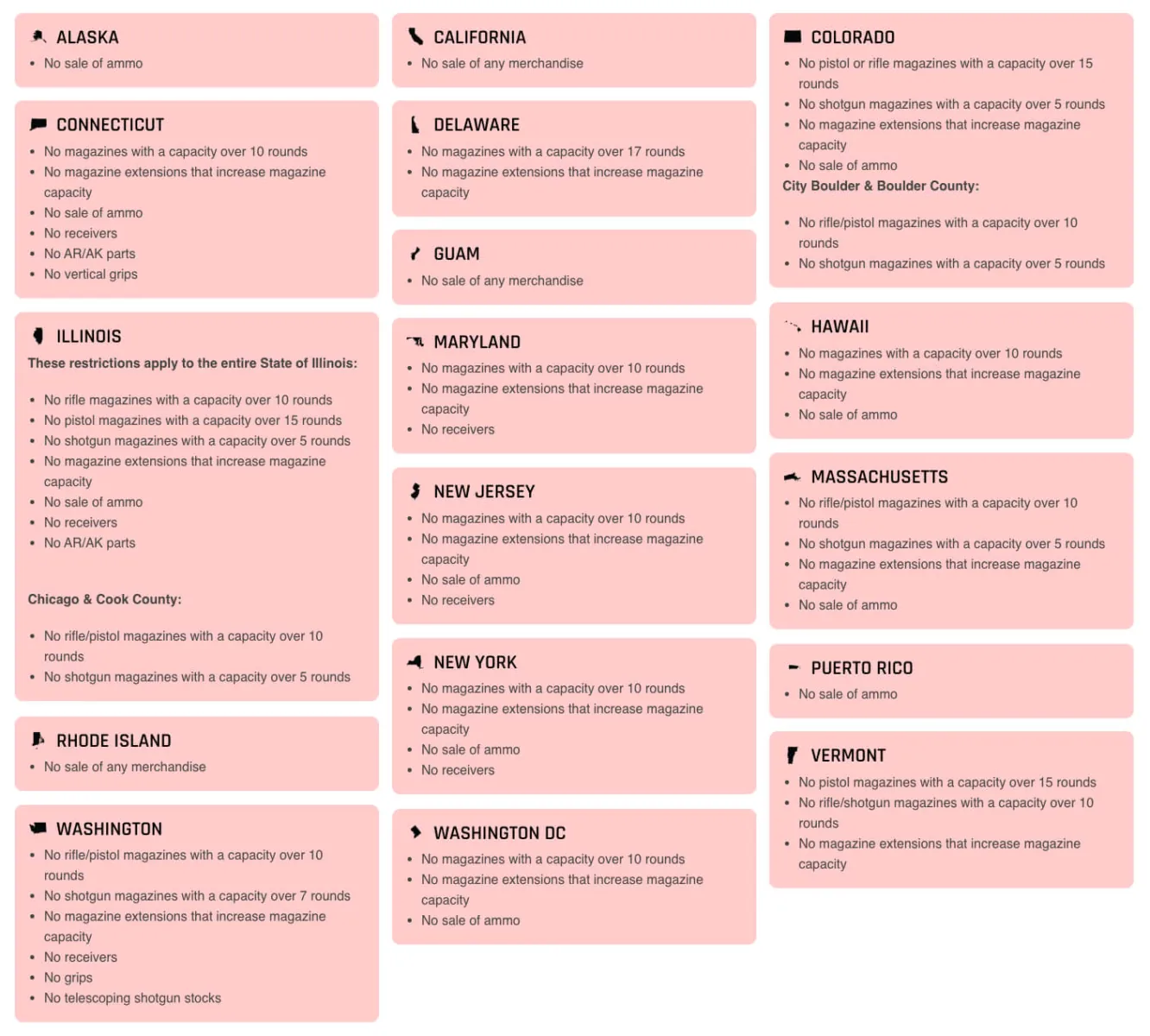
The Mag Shack blocks all orders to Guam, Rhode Island, and California, and puts capacity limits on shipments to some states, including Connecticut, Delaware, Hawaii, Illinois, Maryland, Massachusetts, New Jersey, New York, Vermont, and Washington. That’s our decision layered on top of what the law says, and you’ll see similar filters from other sellers. For more info, visit our Shipping Policy page.
States With No Magazine Capacity Restrictions
States like Texas, Florida, Arizona, Tennessee, Georgia, Alabama, Nevada, and Pennsylvania don’t have a blanket cap, as you see in California or New Jersey. In most of these states, ordering standard and extended-capacity magazines remains routine under state law. Here’s a full list of states with no magazine capacity restrictions:
|
|
|
Still, a state with no magazine capacity restrictions should never be interpreted as “ignore local law.” Columbus, Ohio, is the standing reminder. Ohio has no comparable statewide cap, yet Columbus adopted its own 30-round ordinance, and that litigation is still active.

2026 Law Changes & Court Cases to Watch
The biggest 2026 live developments are in D.C., Virginia, Oregon, California, and Washington, D.C. is volatile because Benson struck down the 10-round ban on March 5, 2026, but additional appellate steps remain possible. Virginia is important because SB 749 has passed the General Assembly and, as of April 2026, is awaiting the Governor’s action; it is not yet law, so any article claiming the new Virginia magazine rule is already in force is jumping ahead of the official status. Oregon remains a litigation and implementation story under Measure 114 and HB 4145.California’s core law remains in force after the Ninth Circuit’s 2025 Duncan decision, with Supreme Court review still pending.Washington’s ban remains in force after the Washington Supreme Court upheld it in 2025, with a cert petition pending.
Frequently Asked Questions
What is a high-capacity magazine?
There is no single official definition across the country right now. The old federal law set the limit at more than 10 rounds, and most states that regulate magazines still use that limit. But there are some exceptions, such as Delaware, which is 17, and a few states set different rules depending on the type of firearm.
Which states have 10-round magazine limits?
As of April, 2026, the main states with 10-round magazine rules are California, Connecticut, D.C., Hawaii (for handgun magazines), Maryland, New Jersey, New York, and Rhode Island.
Are extended mags illegal in the United States?
No. There’s no federal law right now that bans magazines by capacity. Some states and cities have their own restrictions, but in most places, extended magazines are still legal under state law.
Are 30-round magazines legal in all states?
No. Plenty of states ban or limit them, including California, Connecticut, New Jersey, New York, Rhode Island, Washington, and others.
Can I legally order magazines online?
Often, yes, but it depends on where you live, local rules, the magazine’s size, and the seller’s policies. Some retailers will say no to a sale, even if the law isn’t fully clear, because their own rules are stricter than the legal minimum.
Do magazine-capacity laws apply to shotguns?
Sometimes they do. Illinois and cities like Chicago make it clear that shotgun capacity and the use of tube extensions matter when it comes to staying within the law.
Can city laws be stricter than state law?
Absolutely. Boulder, Colorado, and Columbus, Ohio, for example, both show that local rules can go beyond state requirements. State law only covers part of the picture.
Can I drive through a restricted state with prohibited magazines?
Possibly, but it is legally risky. FOPA offers some protection for transporting firearms across states, but it doesn’t give you a free pass on magazine bans. If you’re dealing with high-restriction areas, it’s smart to get legal advice for your particular route.
What happens if I violate magazine capacity laws?
Penalties vary widely. Some states treat violations as misdemeanors, some as felonies, and others impose additional possession penalties on top. You might face confiscation, fines, possible jail time, and even future restrictions on your firearm rights.
How many magazines can I legally carry?
That’s a separate issue from magazine capacity. Most states care about how many rounds fit in each magazine, not how many magazines you actually have on you, though other carry, location, or ammunition rules can still apply.
Important Legal Disclaimer
This guide is provided for informational purposes only and does not constitute legal advice. Laws are complex, and high-capacity magazine laws vary significantly by state and locality, and change frequently. The information presented here was last verified in April 2026, but laws and court rulings may have changed since publication. Pending litigation in several states may alter restrictions without notice. The Mag Shack’s shipping policies reflect our operational decisions and are not legal determinations, as magazine compliance can still be affected by local ordinances, municipal codes, or retailer restrictions, even when a product is legal under state law. Before purchasing or traveling with magazines, you must verify current restrictions by consulting official sources, including your state legislature website, your state attorney general’s office, your local law enforcement, or a qualified firearms attorney. The National Rifle Association’s Institute for Legislative Action (NRA-ILA) and state-specific legislative databases are helpful reference points, but they are not substitutes for official legal counsel. If you are unsure whether a magazine is legal in your jurisdiction, contact your local law enforcement agency or an attorney licensed in your state. Do not rely solely on retailer policies or online guides to determine legality.
Conclusion
Gun magazine capacity laws by state vary in scope and definitions. Each state has its own rules, and even how those rules are enforced can look a little different, so it’s smart to double-check before you buy or move firearms and magazines around. This guide covers which states have limits, how they handle owning and selling magazines, what happens if you’re “grandfathered in,” and how decisions by local governments or stores might affect your purchase plans. So if you want to stay out of trouble, you’ve got to be clear on your state’s exact requirements, plus any others you might pass through. Look up the latest laws, check for local restrictions, and go over shipping rules so you can buy magazines online in a lawful way.