0
Battle of the Optics: LPVO vs Red Dot
LPVOs (Low Power Variable Optic) and red dots are two of the most popular optic options on the market. On one hand, you have an optic that excels at mid to long-range distances but can be challenging in close quarters, and on the other hand, you have an optic that performs well in close quarters but struggles at longer ranges.

URGI rifles are the way. Source
Putting them against each other is not an easy task. It’s not really “LPVO vs. red dot,” it’s which one of these is going to work better for you?
They both have their purpose. Of course, we’ll talk about what I believe to be the best, but before you draw your own conclusions and buy anything, we’ll try to help you decide which is truly best for YOU.
Understanding The Differences
An LPVO is a magnified optic, usually ranging from 1x to 8x (or higher), that allows you to switch between close-quarters, 1x shooting and longer-range precision with higher magnification. It typically features an etched reticle and sometimes offers illumination.
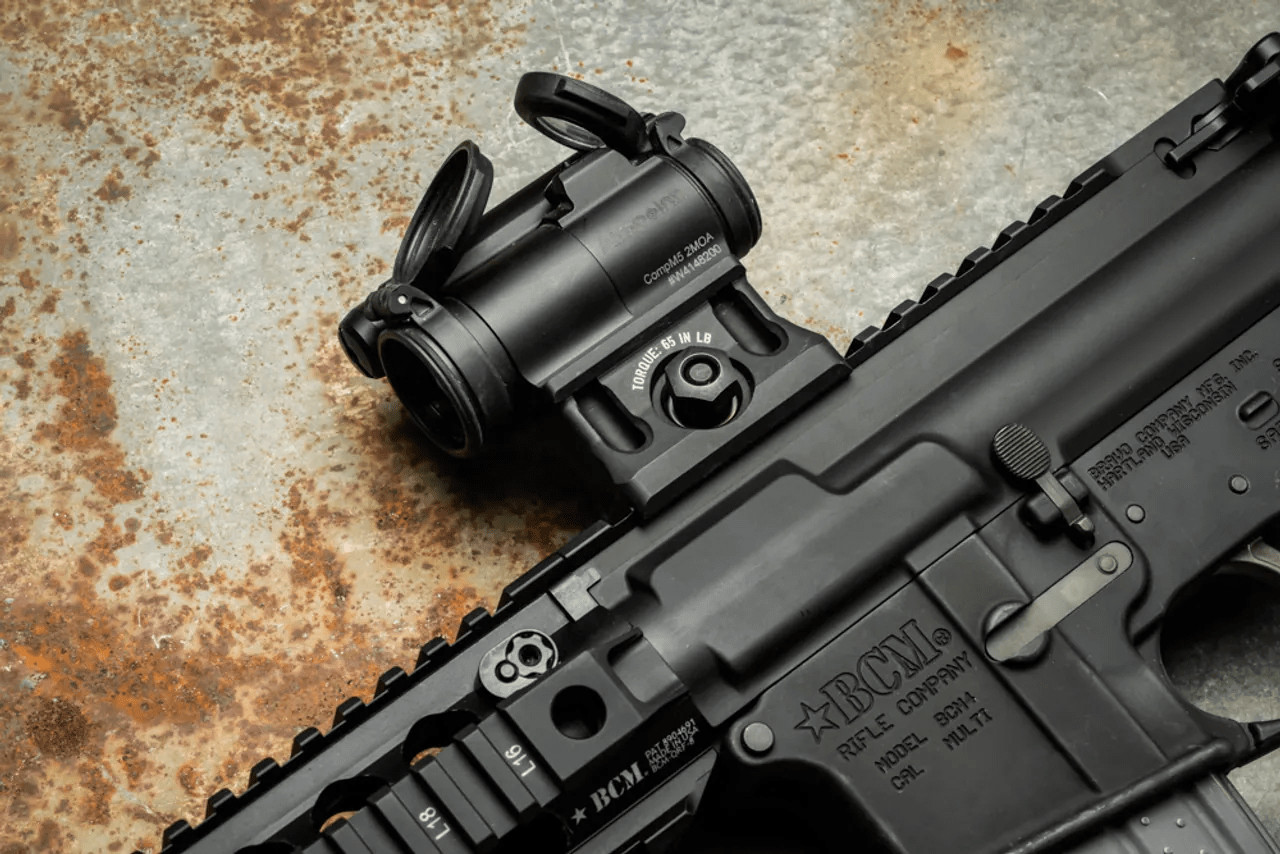
Red dots are also nice and compact for smaller builds. Source
A red dot sight, on the other hand, is a non-magnified optic that projects a single illuminated dot (or other reticle style) onto a lens, allowing for extremely fast target acquisition at close range. Red dots are ideal for quick, instinctive shooting and can be easier to use in a broader range of lighting conditions.
Which One Is Better?
This is purely my opinion, and I’m sure many fine shooters would disagree, but if I had to choose only one, I would opt for the red dot.
This is from a civilian standpoint, but nine times out of ten, you’re not going to be using an LPVO that far out in a defensive situation. And if you do, you’re probably going to prison. Red dots work more effectively in a defensive setting because of your proximity to a target, and if you want to reach out any further, you can always add a magnifier.
But even with a magnifier, when it comes to home defense or any other defensive situation, you’re most likely not going to need it. If you have to flip your magnifier up, it won’t be considered a defensive situation in court because “the ‘victim’ was not close enough to be considered a threat.”

You can always have both. Source
Now this changes entirely if you are a police officer or military. Sometimes the target is close, and sometimes it is far; in that case, you would want something more versatile and precise, like an LPVO.
But for the average civilian like you and me, a red dot will suffice in a defensive situation.
However, if you partake in shooting sports or hunting, or simply want to test your rifle’s accuracy, an LPVO is still a great option.
Which One Is Better For You?
Refer to the last paragraph. Which do you fall under? If you’re looking for an optic for your home defense gun, you’ll likely want to opt for a red dot. Unless you happen to live in a mega mansion, your house is small enough for a red dot to suffice.
SHTF build? Red dot with a magnifier. Trust me, the last thing you want to do is go shooting at a distance and attract the enemy.
But if you’re using your rifle for target shooting and occasionally like to stretch your legs, then absolutely go with an LPVO. I personally run an EOTech VUDU with a Leupold DPP on top. It’s got the best of both worlds. If I want to shoot at a distance, I have the LPVO. If I need quick acquisition, then I have the Delta Point Pro.
Who Makes The Best Optics?
By now, you should have a good idea of which one is better for you and your needs. Now we get on to which ones are the best. Typically, when it comes to optics, I judge based on the glass, build quality, and durability.
For the cost compared to the quality, the EOTech Vudu is easily one of the best on the market. The Japanese-made glass is clear, the reticle is bright, and zeroing is so easy that even your dog could do it. It’s also highly durable and holds that zero without issue.
Top-tier LPVO? NightForce ATAC-R. These things are damn-near indestructible and built with the best components money can buy. They’re expensive, but if you can spare the change, they are more of an investment than just another piece on your rifle.
If you want to save some money and not sacrifice quality, consider some of the LPVOs from Primary Arms, trust me.

Buy once, cry once. Source
As for red dots, I’m partial to AIMPOINT because I love my Micro T1 and magnifier setup. I’ve dragged it through the dirt and through thousands of rounds, and it has never lost zero, and it has never given up on me.
On the budget end of the spectrum, Sig Sauer makes a great red dot. And its new iterations are highly sophisticated when used with a magnifier. I wouldn’t want to abuse it as much as I do my AIMPOINT, but it will work for most of us.
Last but certainly not least, Holosun offers some great middle-of-the-road options that also have some of the most technologically advanced features you’ll find.
Remember Your Barrel Length (5.56/7.62)
This is also important when choosing an optic. If you’re running an 11.5-inch barrel, you’re probably not looking to punch out to 500-plus yards anyway. 12.5 inches and below are meant for shorter-range optics because 5.56×45 does not do as well from shorter lengths.
However, if you have a 14.5-inch barrel or longer, you can still achieve solid velocity with the 5.56 round and are capable of shooting relatively far with the correct ammunition. Therefore, if you typically use a barrel of this length, an LPVO may make more sense.

Red dots work best in closer quarters and shorter barrels. Source
Conclusion
Choosing between a red dot and an LPVO, or deciding which one is better, all boils down to what you need it for. Here’s the short answer: one is not better than the other.
If you need proof of that, go hunting with a red dot or run close-quarters drills with an LPVO. You’ll quickly discover that both serve their purpose, much like a Porsche on the track and a 4Runner in the woods.
The real question is this. Which one is better for you?
Be good and take care.